


A chuck roast, a hot Dutch oven, and a low oven do most of the work here. After about three hours the beef pulls apart with a fork, the carrots are sweet and tender, and the braising liquid turns into a proper gravy. Spoon it all over creamy mashed potatoes and you have the Sunday dinner that actually earns the wait.
At a glance
Pot roast with mashed potatoes is a classic American braised dinner: beef chuck roast seared, then cooked low and slow in beef broth with onion, garlic, thyme, and carrots, served over buttery mashed potatoes with gravy made from the pot.
- Prep time: 25 minutes
- Cook time: 3 hours 30 minutes
- Total time: 3 hours 55 minutes (includes 15 minutes resting)
- Difficulty: Easy — mostly hands-off once it is in the oven
- Servings: 6
- Method: Dutch oven, oven-braised at 325°F (163°C)
The roast is done when a fork slides in with almost no resistance, usually at 195–205°F (91–96°C) inside. That is well past the USDA safe minimum of 145°F (63°C) for beef roasts, with a 3-minute rest — pot roast needs the extra heat and time for the tough connective tissue in chuck to turn tender.
Ingredients
For the pot roast
- 3 lb (1.4 kg) boneless beef chuck roast
- 1½ tsp kosher salt
- 1 tsp freshly ground black pepper
- 2 tbsp olive oil
- 1 large yellow onion, chopped
- 4 garlic cloves, minced
- 2 tbsp tomato paste
- 2 cups low-sodium beef broth
- 1 tbsp Worcestershire sauce
- 4 sprigs fresh thyme (or 1 tsp dried thyme)
- 2 bay leaves
- 1 lb carrots, peeled and cut into 2-inch chunks
Why chuck? Chuck is well-marbled and full of collagen. Cooked fast it is tough; braised low and slow, that collagen melts into gelatin and the meat turns moist and shreddable. Leaner cuts such as round dry out more easily here.
Alternatives: A 3–4 lb chuck roast works the same way — allow about 45–60 minutes per pound at 325°F and start checking early. Brisket also braises well but needs longer. Skip pre-cut “stew meat” for this recipe; the pieces dry out and the timing changes.
For the mashed potatoes
- 2 lb Yukon Gold potatoes, peeled and cut into 1½-inch chunks
- 1 tbsp kosher salt, for the cooking water
- 4 tbsp unsalted butter
- ½–¾ cup warm whole milk
- ¼ cup sour cream, optional, for tang and extra creaminess
- Salt and black pepper, to taste
- 2 tbsp chopped fresh chives, optional, for serving
Why Yukon Golds? They mash into a dense, silky, naturally buttery purée. Russets give a lighter, fluffier mash; half Yukon Gold and half russet is a good middle ground. Avoid waxy red potatoes for mashing — they turn gluey if overworked.
For the gravy
- 2 tbsp all-purpose flour
- ¼ cup cold beef broth
Alternative: For gluten-free gravy, use 1 tbsp cornstarch mixed with 2 tbsp cold water instead of the flour.
Equipment
- 5–7 quart Dutch oven with a tight-fitting lid
- Large pot for the potatoes
- Potato masher or ricer
- Tongs
- Instant-read thermometer
- Cutting board and sharp knife
A tight lid matters more than the brand of pot — it traps steam and keeps the braising liquid from evaporating too fast.
How to make pot roast with mashed potatoes
Step 1 — Heat the oven and season the roast
Heat the oven to 325°F (163°C). Pat the chuck roast completely dry with paper towels and season all over with the salt and pepper. Dry meat browns; wet meat steams.
Step 2 — Sear until deeply browned
Heat the olive oil in the Dutch oven over medium-high heat until it shimmers. Sear the roast 4–5 minutes per side, including the edges, until a deep brown crust forms. Do not move it while it sears. Lift it out to a plate. A pale roast makes a pale, flat-tasting broth; a well-browned one makes a rich gravy.

Step 3 — Build the braising base
Lower the heat to medium. Cook the onion in the same pot for about 5 minutes, until softened, scraping up the browned bits from the bottom. Stir in the garlic and tomato paste and cook 1 minute more — the paste should darken slightly and smell sweet, not scorched. Pour in the beef broth and Worcestershire sauce and scrape the bottom again.

Step 4 — Braise low and slow
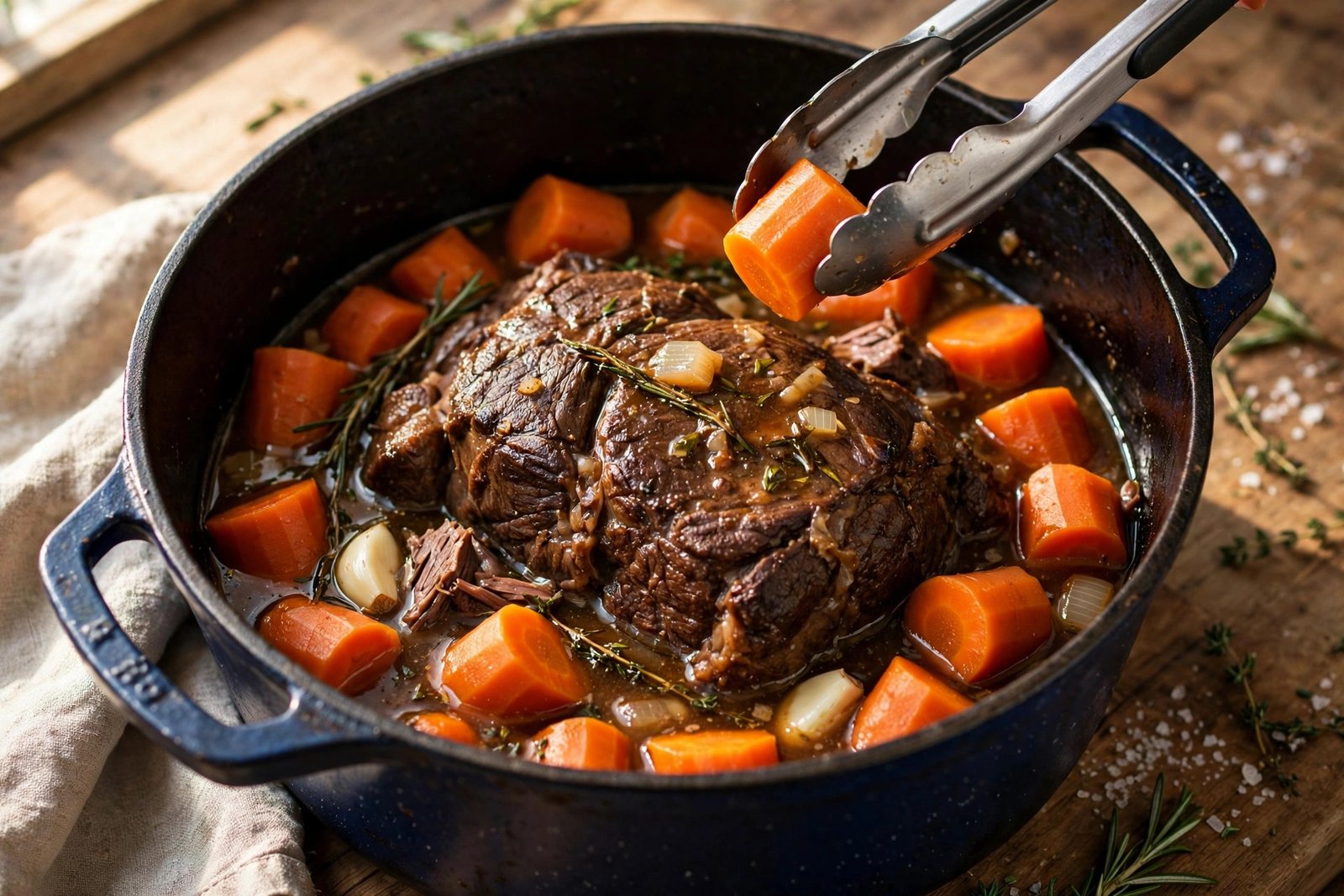
Return the roast to the pot with the thyme and bay leaves. The liquid should come about halfway up the sides of the roast, not cover it completely. If the roast is fully submerged you are boiling it, not braising it, and the sauce will be thin. Cover tightly and put in the oven for 2 hours.

Step 5 — Add the carrots
After 2 hours, nestle the carrots around the roast and spoon some liquid over them. Cover and braise 60–75 minutes more, until the meat pulls apart easily with a fork and a knife slides easily through the carrots. For a 3 lb roast the total braise is about 3–3½ hours. Check with a thermometer if you like: fork-tender is usually 195–205°F (91–96°C).
Step 6 — Start the mashed potatoes
While the roast finishes, put the potato chunks in a large pot, cover with cold water by 1 inch, and add the salt. Bring to a boil, then reduce to a gentle simmer for 15–20 minutes, until a fork slides into a chunk with no resistance. Drain well, return the potatoes to the hot pot, and let them steam dry for 1 minute.
Step 7 — Mash, gently
Warm the milk (cold milk cools the potatoes and makes them stiff). Mash the potatoes with a masher or ricer, then add the butter, ½ cup of the warm milk, and the sour cream if using. Mash just until smooth, adding the remaining milk a little at a time if needed. Stop as soon as it is smooth — over-mashing makes potatoes gluey. Season with salt and pepper.

Step 8 — Rest the roast and make the gravy
Lift the roast to a cutting board and rest it 15 minutes, loosely covered. Resting lets the juices settle so the meat does not dry out when you shred it. Meanwhile, skim fat from the surface of the braising liquid. Whisk the flour with the ¼ cup cold broth until smooth, stir it into the pot, and simmer on the stove for 5–8 minutes, until the gravy coats the back of a spoon. Season to taste and remove the thyme stems and bay leaves.
Step 9 — Serve
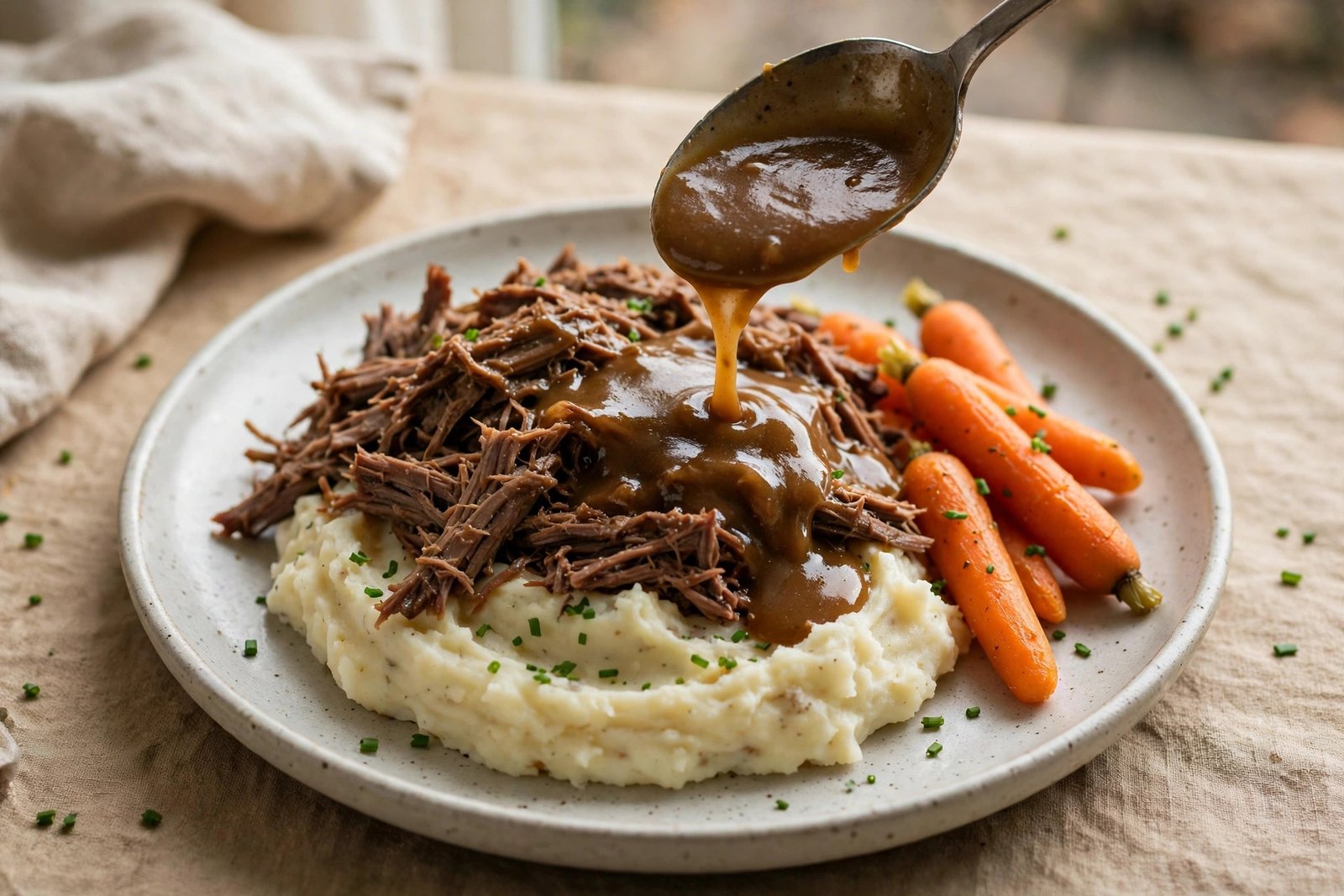
Pull the beef into large tender pieces or slice it thick. Serve over a generous spoonful of mashed potatoes with the carrots alongside, and ladle gravy over the top. Sprinkle with chives if you like.
Tips for the best pot roast
- Do not rush it. If the meat is still firm at 3 hours, it is undercooked, not overcooked. Keep braising and check again in 20–30 minutes. Pot roast gets tender by cooking longer, not by turning the oven up.
- Keep the lid on. Every time you lift it, steam escapes and the pot cools. Check once when you add the carrots, then leave it alone.
- Add vegetables late. Carrots added at the start turn to mush in 3 hours. Added for the last hour, they stay tender and hold their shape.
- Warm the milk and butter. Cold dairy makes mashed potatoes stiff and lumpy.
- Taste the gravy last. The broth reduces as it cooks, so it gets saltier. Season only after it has thickened.
Variations and substitutions
- Slow cooker: Sear and build the base as above, then cook on LOW for 8–10 hours or HIGH for 5–6 hours, adding the carrots for the last 60–90 minutes. Make the mashed potatoes just before serving.
- Red wine: Replace ½ cup of the beef broth with dry red wine for a deeper gravy.
- Herbs: Swap the thyme for 2 sprigs of rosemary, or add both.
- Extra vegetables: Parsnips or celery root can go in with the carrots for the last hour. Mushrooms can be sautéed separately and stirred in at the end.
- Dairy-free mash: Use olive oil and warm oat milk or unsweetened almond milk in place of butter and milk. The mash will be lighter but still creamy.
- Gluten-free: Use the cornstarch slurry for the gravy (see Ingredients) and check that your Worcestershire sauce and broth are labelled gluten-free.
Storage and reheating
Cool leftovers within 2 hours and store in shallow, airtight containers. Cooked pot roast keeps 3–4 days in the fridge or up to 3 months in the freezer. Mashed potatoes keep 3–4 days in the fridge; they freeze less well and can turn grainy, so freeze the roast and gravy together and make fresh mash if you can.
Reheat gently, covered, with a splash of broth: in a 325°F (163°C) oven until heated through, or on the stove over medium heat. Reheat leftovers to 165°F (74°C). Do not reheat leftovers in a slow cooker — it warms too slowly. Reheat each portion once only.
Allergens and dietary information
Contains milk/dairy (butter, milk, sour cream) and wheat/gluten (flour in the gravy). Worcestershire sauce usually contains anchovy (fish) and may contain soy — check the label. Beef broth can contain soy or wheat, so check the label if that matters to you.
This recipe is not gluten-free or dairy-free as written, but the variations above cover both. It is not suitable for a beef or dairy allergy without substitutions. Do not label it allergy-safe for a shared kitchen without checking for cross-contact.
Nutrition (estimated)
Estimated per serving (1 of 6, about 1 cup of pot roast with carrots and gravy plus about ¾ cup mashed potatoes). These are estimates, not laboratory-tested values — they will change with the exact cut, how much fat you trim, and how much gravy you serve.
Calories 580 kcal, Protein 42 g, Carbohydrates 38 g, Fat 28 g, Saturated fat 11 g, Cholesterol 115 mg, Sodium 720 mg, Potassium 980 mg, Fiber 4 g, Sugar 6 g, Calcium 65 mg, Iron 4.6 mg.

Pot Roast with Mashed Potatoes
Ingredients
Equipment
Method
- Heat the oven to 325°F (163°C). Pat the chuck roast completely dry with paper towels and season all over with the salt and pepper.
- Heat the olive oil in the Dutch oven over medium-high heat until it shimmers. Sear the roast 4 to 5 minutes per side, including the edges, until a deep brown crust forms. Do not move it while it sears. Lift it out to a plate.
- Lower the heat to medium. Cook the onion for about 5 minutes, until softened, scraping up the browned bits. Stir in the garlic and tomato paste and cook 1 minute more. Pour in the beef broth and Worcestershire sauce and scrape the bottom again.
- Return the roast to the pot with the thyme and bay leaves. The liquid should come about halfway up the sides of the roast. Cover tightly and braise in the oven for 2 hours.
- Nestle the carrots around the roast and spoon some liquid over them. Cover and braise 60 to 75 minutes more, until the meat pulls apart easily with a fork and a knife slides easily through the carrots. Total braise time is about 3 to 3 1/2 hours; fork-tender is usually 195 to 205°F (91 to 96°C) inside.
- While the roast finishes, put the potato chunks in a large pot, cover with cold water by 1 inch, and add the salt. Bring to a boil, then simmer gently for 15 to 20 minutes, until a fork slides into a chunk with no resistance. Drain well and let the potatoes steam dry for 1 minute.
- Mash the potatoes with a masher or ricer, then add the butter, 1/2 cup of warm milk, and the sour cream if using. Mash just until smooth, adding the remaining milk a little at a time if needed. Season with salt and pepper.
- Lift the roast to a cutting board and rest it 15 minutes, loosely covered. Skim fat from the braising liquid. Whisk the flour with the 1/4 cup cold broth until smooth, stir it into the pot, and simmer 5 to 8 minutes, until the gravy coats the back of a spoon. Remove the thyme stems and bay leaves and season to taste.
- Pull the beef into large tender pieces or slice it thick. Serve over mashed potatoes with the carrots alongside and ladle gravy over the top. Sprinkle with chives if you like.
Notes
Frequently asked questions
What cut of beef is best for pot roast?
Boneless chuck roast. It is well-marbled and rich in collagen, which is exactly what breaks down into gelatin during a long, slow braise. Round and rump are leaner and dry out more easily.
How long does pot roast take in the oven?
About 3–3½ hours for a 3 lb chuck roast at 325°F (163°C), covered, after searing. Use 45–60 minutes per pound as a guide, then finish with the fork test — the meat should pull apart with almost no resistance.
What temperature is pot roast done at?
Fork-tender is usually 195–205°F (91–96°C) inside. The USDA safe minimum for beef roasts is 145°F (63°C) with a 3-minute rest, but a pot roast at 145°F would still be tough — it needs the higher temperature to break down collagen.
Can I make pot roast in a slow cooker?
Yes. Sear and build the base first, then cook on LOW for 8–10 hours or HIGH for 5–6 hours. Add the carrots for the last 60–90 minutes so they do not turn to mush.
Why is my pot roast tough?
It almost always means it needs more time, not less. Collagen only turns tender after a long hold at a high internal temperature. Keep the lid on, keep braising, and check again in 20–30 minutes.
Can I make it ahead?
Yes. Cook it fully, cool it within 2 hours, and refrigerate the beef in its braising liquid for up to 3–4 days. Reheat gently, covered, with a splash of broth, then make the mashed potatoes fresh.
What potatoes are best for mashed potatoes?
Yukon Golds for a creamy, buttery mash, russets for a lighter, fluffier one, or half of each. Start them in cold salted water, drain well, and use warm milk and butter.
Can I freeze leftover pot roast?
Yes — the beef and gravy freeze well for up to 3 months in airtight containers. Thaw overnight in the fridge and reheat to 165°F (74°C). Mashed potatoes can be frozen too, but their texture is better fresh.

8 Comments
Pingback: Honey BBQ Chicken and Garlic Parmesan Potatoes
Pingback: Creamy Chicken Gnocchi Soup in 45 Minutes
Pingback: Street Corn Sweet Potato Bowl (Easy, 45 Minutes)
Pingback: Crispy Smashed Potato Board (Party Appetizer)
Pingback: Orange Glazed Salmon — Sweet, Sticky & Ready in 25 Minutes
Pingback: Pomegranate Lamb Chops with Rosemary and Honey
Pingback: Crispy Roasted Cabbage Steaks (Easy, 45 Minutes)
Pingback: Easy Aloo Gobi — Potato and Cauliflower Curry