


Jump to recipe ↓
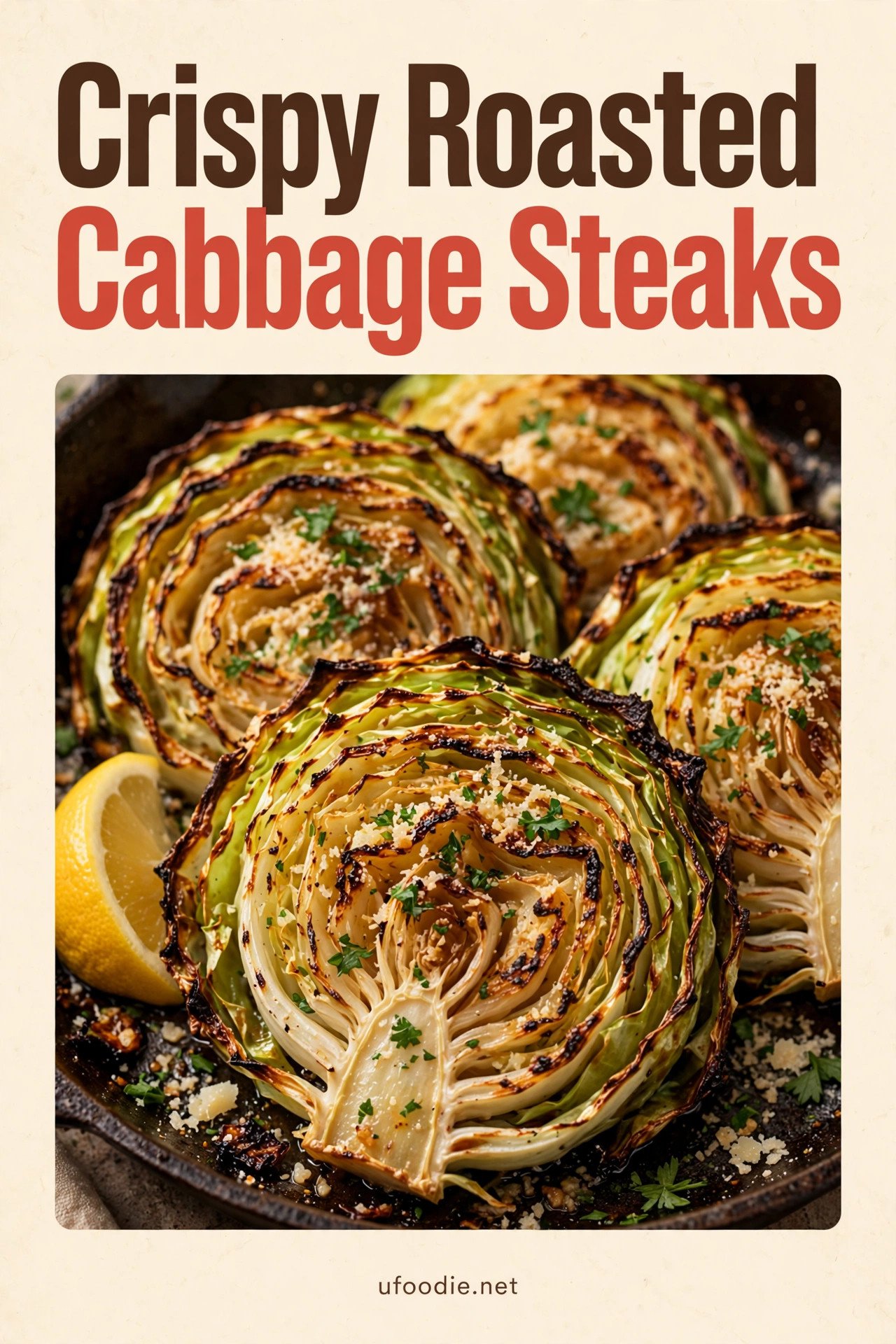
A whole head of cabbage, four thick slices, one hot oven — and about 45 minutes later I have something that tastes like it came from a farm-to-table restaurant. The edges go dark gold and shatter-crisp like kale chips, the centre turns silky and sweet, and the whole thing costs less than a dollar a serving.
Cabbage is the vegetable I used to walk past — plain, old-fashioned, and too often boiled soft and grey. Roasting changes everything: the natural sugars caramelise, the outer leaves crisp, and the flavour turns nutty and sweet.
Slice, brush with a garlicky smoked-paprika oil, roast, flip, shower with Parmesan, and serve.
At a glance
- Servings: 4 steaks (as a side dish; 2 as a light main)
- Prep time: 10 minutes
- Cook time: 35 minutes
- Total time: 45 minutes
- Oven temperature: 425°F (218°C)
- Why this recipe: one pan, one cheap cabbage, edges that go shatter-crisp while the centre turns silky and sweet
- Storage: fridge 3–4 days in an airtight container; do not freeze
- Done when: deeply golden on both sides and the centre is fork-tender — a knife slides into the thickest part of the core with no resistance
Why you’ll love this recipe
- It turns the cheapest vegetable in the shop into the best thing on the plate. Caramelised edges, a sweet silky centre, less than a dollar a serving.
- It is one pan and ten minutes of prep. Slice, brush, roast, flip — no shredding, no braising, no special equipment.
- It works as a side or a light main. Next to roast chicken or salmon, or one steak per person with a fried egg on top.
- It is naturally low-carb and gluten-free. About 7 g of net carbs per steak, and the only allergen is the Parmesan.
Notes on ingredients
Green cabbage. The classic choice — it holds its shape, caramelises well, and turns sweet in the oven. Savoy works too and is slightly more tender. Red cabbage also works; it is a little sweeter and turns a deep roasted purple, though the colour can bleed onto the pan. Pick a head that feels heavy and dense, with tight leaves and no soft spots or dark patches.
Olive oil. This is doing real work, not just preventing sticking. It carries the seasoning into the leaves and helps the edges crisp. Use a good extra-virgin olive oil. Melted butter works too, or half butter and half oil for extra browning — but butter alone can burn at 425°F, so keep the oil in the mix.
Garlic powder, not fresh garlic. Fresh minced garlic burns over a 35-minute roast at 425°F and turns bitter. Garlic powder seasons evenly and survives the heat. If you love fresh garlic, add it in the last 5 minutes with the Parmesan instead.
Smoked paprika. The single most important seasoning here — a warm, smoky depth that plain salt and pepper cannot give. Sweet paprika works if that is what you have; hot paprika adds heat. Do not skip it.
Parmesan. Finely grated Parmesan melts into a salty, savoury crust in the last 5 minutes. Pecorino Romano is a sharper swap. For a dairy-free version, leave it out and finish with a drizzle of balsamic glaze instead.
Lemon. Not optional in spirit. A squeeze of lemon over the hot steaks right before serving lifts the whole dish — the acid cuts the richness of the oil and cheese and keeps the cabbage from tasting heavy.
Find the complete recipe with measurements below.
How to make crispy roasted cabbage steaks
Stage 1 — Cut the steaks
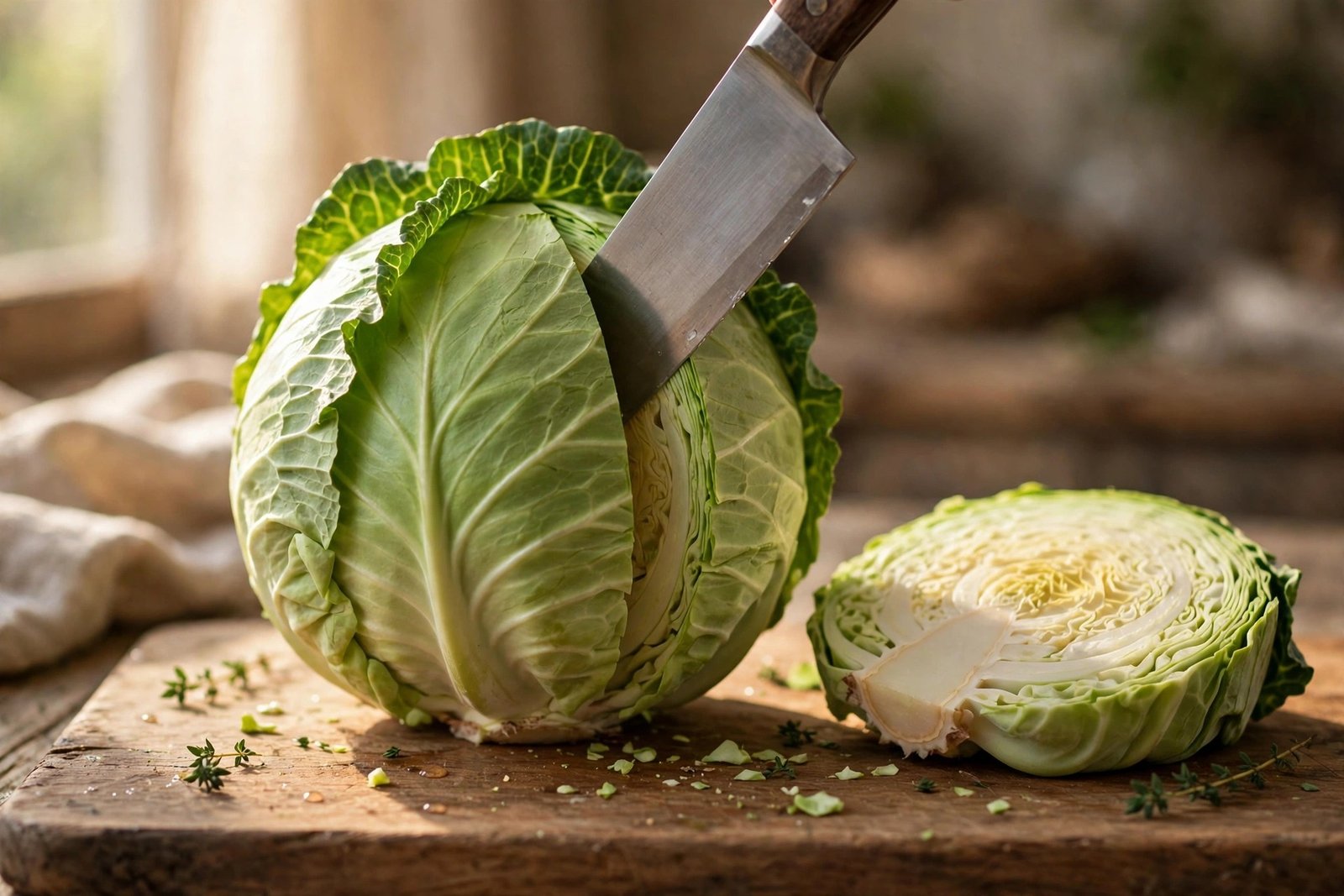
Heat the oven to 425°F (218°C) with a rack in the centre and line a large rimmed baking sheet with parchment paper. A hot oven is the whole trick: 425°F is hot enough to caramelise the outer leaves and crisp the edges while the inside steams tender.
Pull off any loose or damaged outer leaves. Trim just the bottom of the core so the cabbage stands flat — do not cut the core out. Stand the cabbage upright and slice straight down through the core into 4 steaks, each about 1 inch thick. The core is what holds each slice together; remove it and the steak falls apart. Thinner than ¾ inch and the slices fall apart and dry out; thicker than 1½ inches and the centre stays raw. One inch, core intact, is the sweet spot.
You will get two thick centre steaks and two thinner end pieces — the end pieces roast faster and crisp up like chips, so pull them a few minutes early if they look done. If you washed the head, pat it dry before oiling: water on the surface steams instead of roasting.
Stage 2 — Season and arrange
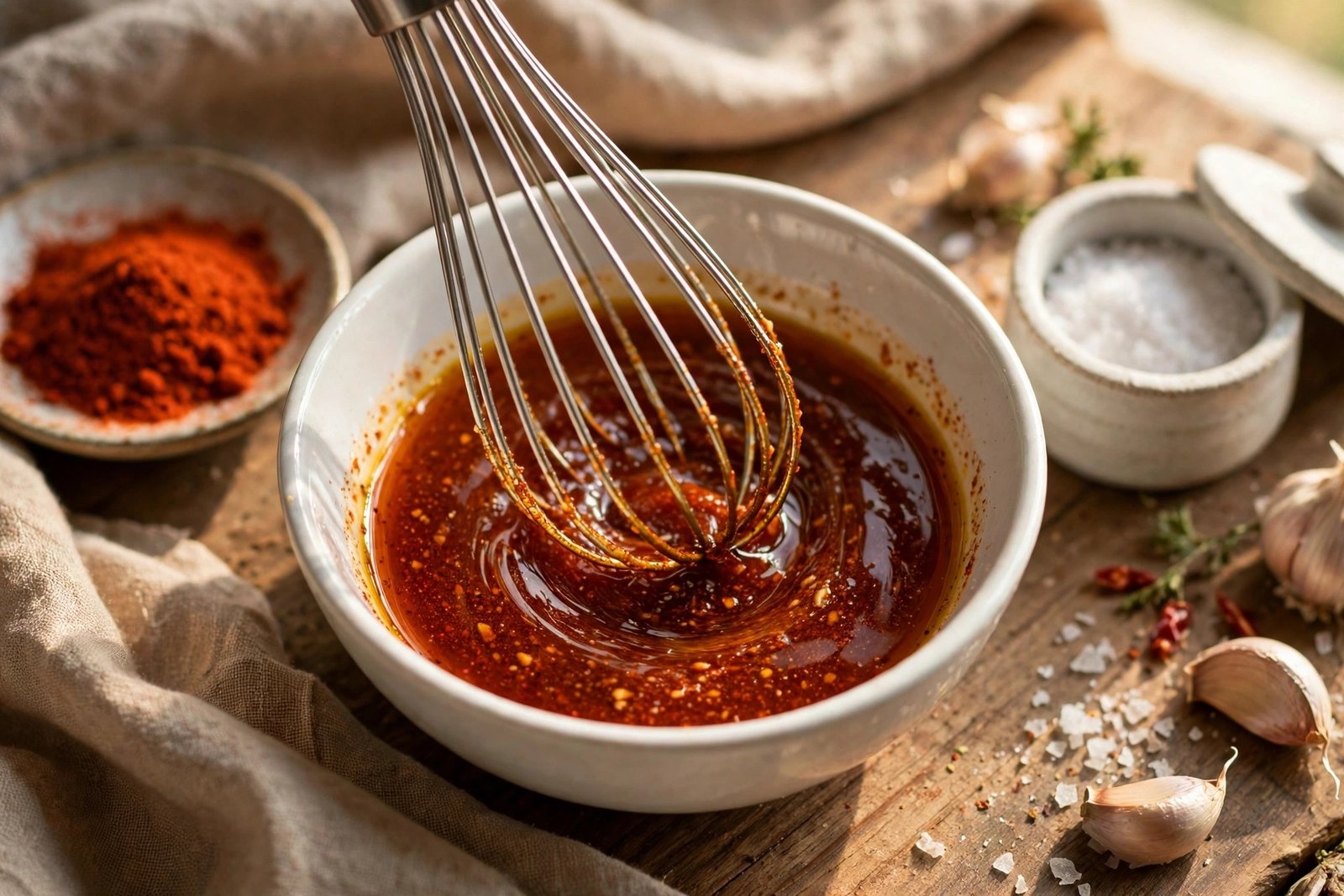
In a small bowl, whisk together the olive oil, garlic powder, smoked paprika, salt, and black pepper. It should look like a rusty-red, fragrant oil. This is the only seasoning the cabbage needs before roasting; everything else goes on at the end.
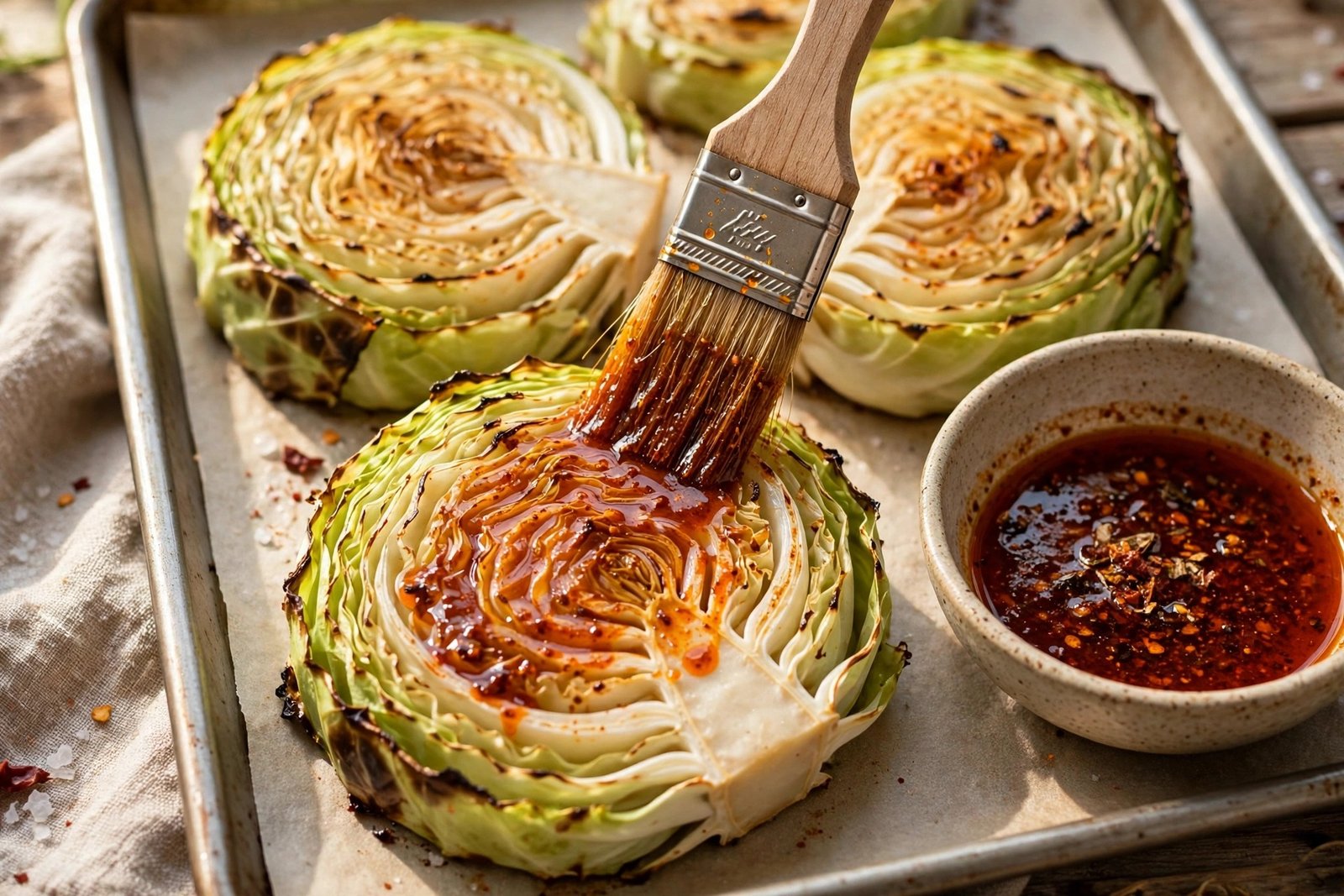
Lay the steaks in a single layer on the prepared pan, leaving at least 1 inch of space between them. Brush the tops generously with the seasoning oil, getting it into the layers at the edges. Crowded steaks trap steam, and steamed cabbage never crisps, so use two pans rather than squeezing them together. Brush generously — a light brush gives pale, limp cabbage; the oil is what fries the outer leaves crisp.
Stage 3 — Roast and flip
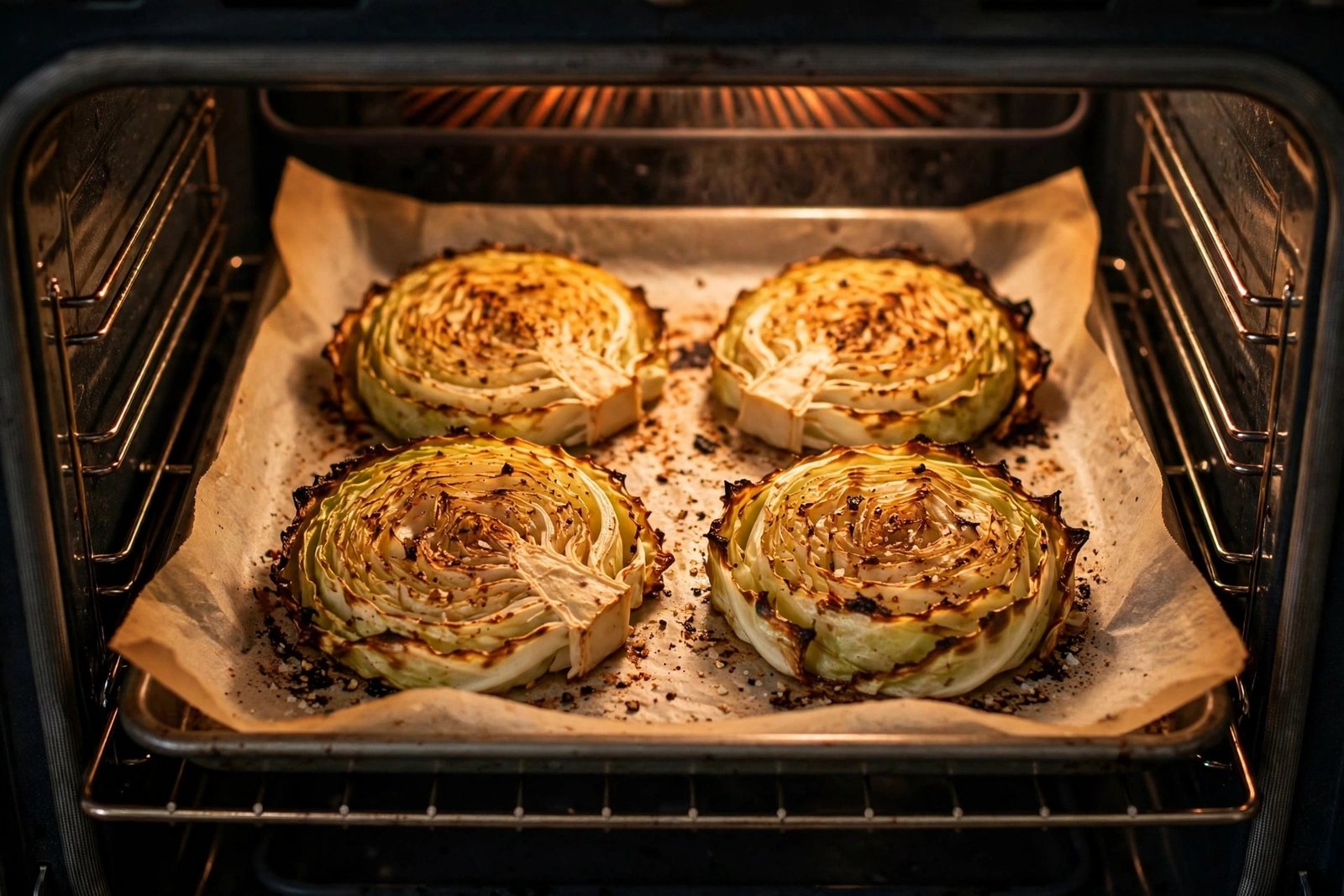
Roast for 15 to 18 minutes, without opening the oven — every time you open the door, the temperature drops and the edges steam. When you peek, the underside should be golden to deeply browned at the edges and the top leaves starting to curl and crisp.
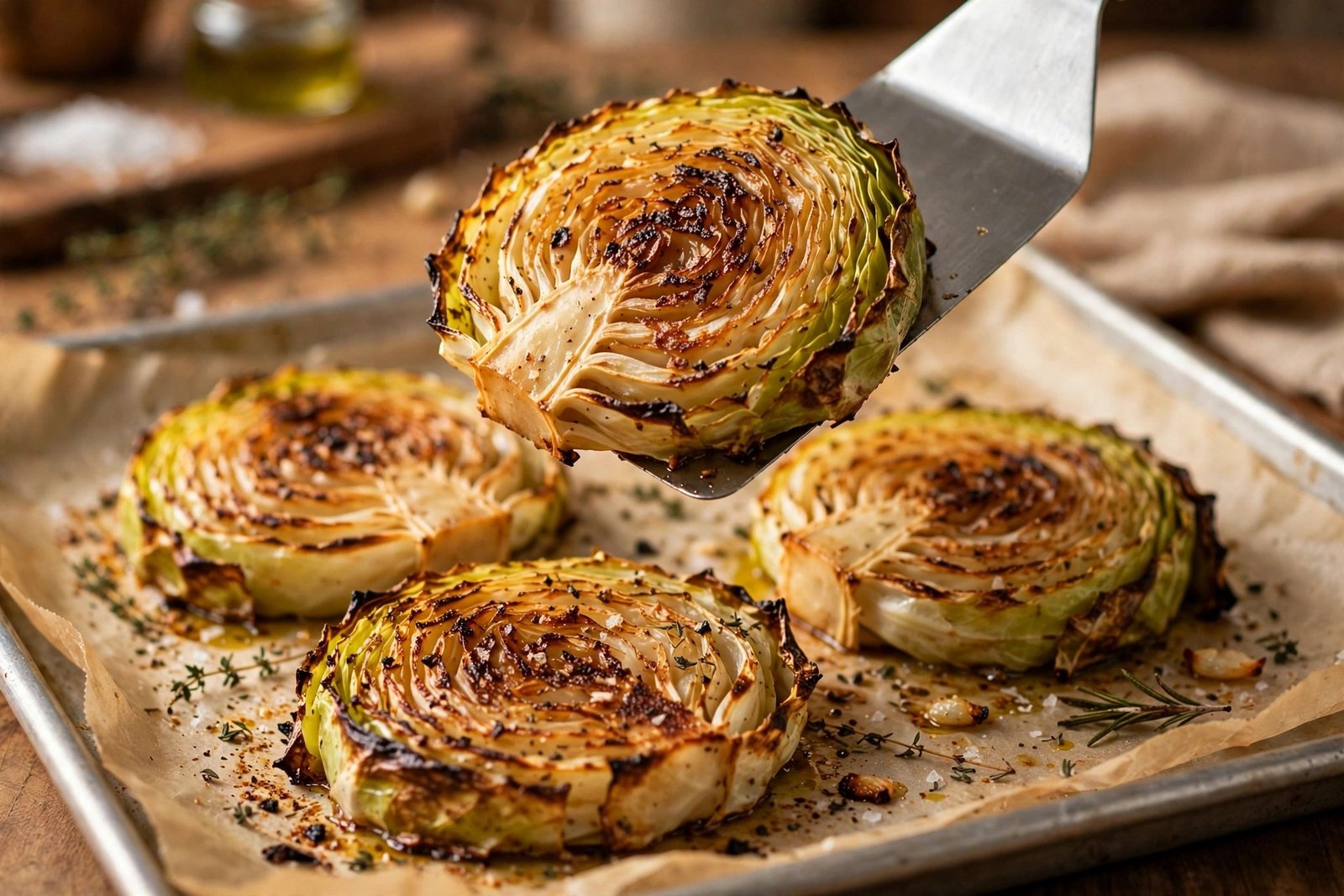
Flip each steak carefully with a wide spatula — use two spatulas, one under each half, to support the full width so it stays in one piece. Brush the second side with the remaining seasoning oil and roast 12 to 15 minutes more, until the second side is deeply golden and the centre is fork-tender all the way through. Total roasting time is 30 to 35 minutes; older, denser heads or steaks thicker than 1 inch can need up to 40 minutes, so keep roasting in 5-minute increments until the core is tender. If the edges burn before the centre is tender, lower the heat to 375°F (190°C), cover loosely with foil, and keep roasting.
Stage 4 — Parmesan, rest and serve
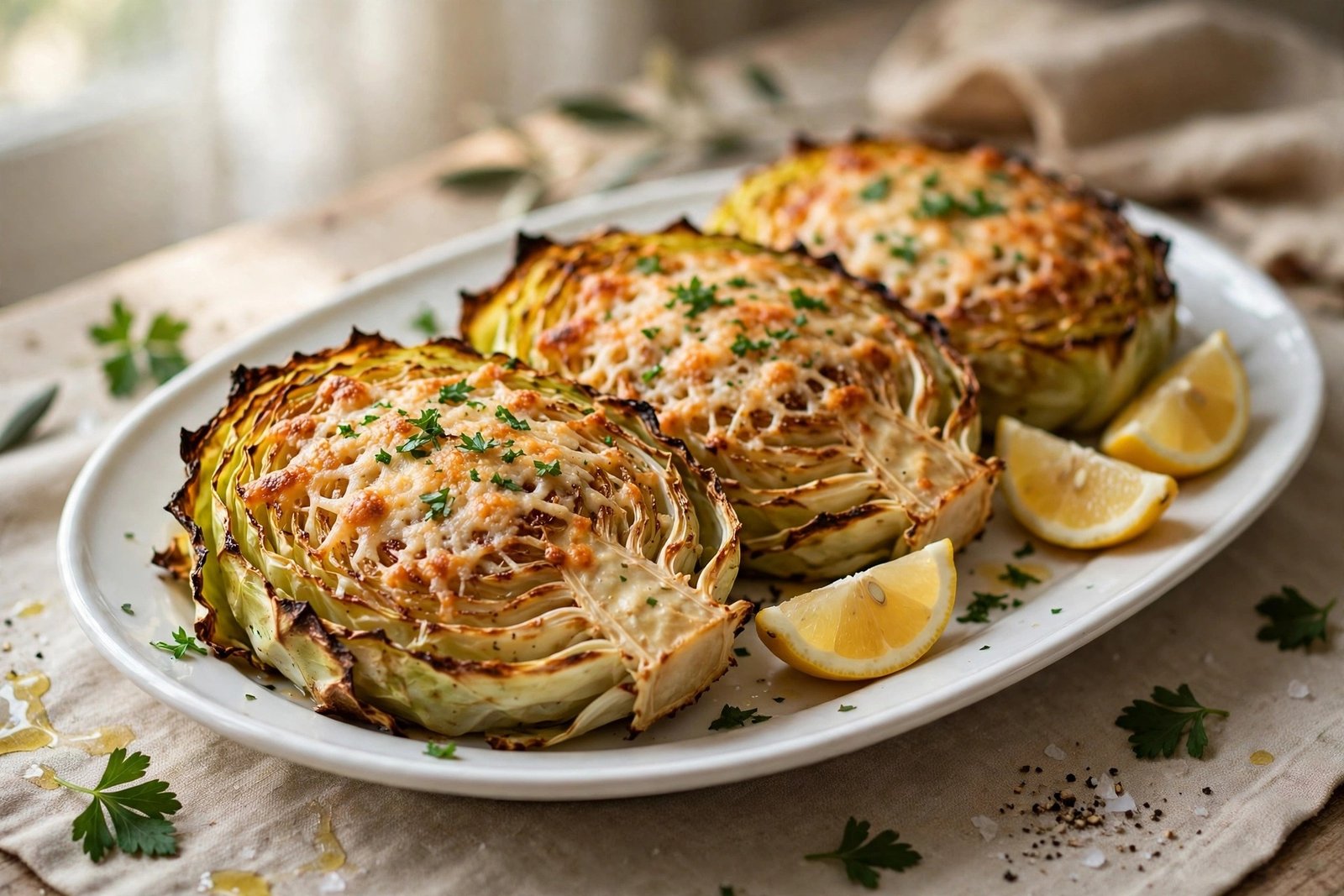
In the last 5 minutes of roasting, sprinkle the grated Parmesan evenly over the steaks and return the pan to the oven. The cheese melts into a salty crust — it only needs those last 5 minutes, and if it goes on too early it burns. If the edges still look pale, switch the oven to broil for 1 to 2 minutes — watch it constantly, because the line between deeply golden and burnt is about 60 seconds under a broiler.
Let the steaks rest on the pan for 2 to 3 minutes — they firm up slightly and are easier to move. Transfer to a platter, scatter over the parsley, and serve immediately with lemon wedges. Serve while the edges are still crisp: they soften noticeably within about 15 minutes as moisture migrates out from the interior. As a side they sit next to roast chicken, salmon, pork chops or steak; as a light main, serve one steak per person with a fried or poached egg and crusty bread.
Storage and reheating
Cool the steaks completely, then store in an airtight container in the fridge for 3 to 4 days. The FoodSafety.gov Cold Food Storage Chart (https://www.foodsafety.gov/food-safety-charts/cold-food-storage-charts) confirms the 3 to 4 day fridge limit for cooked leftovers, and leftovers should go into the fridge within 2 hours of cooking — 1 hour if the room is above 90°F.
Do not freeze roasted cabbage steaks; the texture turns soft and watery on thawing. Reheat in a 400°F (200°C) oven for 5 to 8 minutes on a lightly oiled sheet pan, or in the air fryer at 375°F for 4 to 5 minutes, until hot and the edges crisp up again. Avoid the microwave — it makes the steaks soggy and the Parmesan rubbery.
Variations
- Garlic Parmesan (the classic): As written — garlic powder in the oil, Parmesan in the last 5 minutes, lemon and parsley to finish. The version to make first.
- Italian-style: Swap the smoked paprika for 1 tsp Italian seasoning; finish with Pecorino Romano and balsamic glaze.
- Spicy: Add ½ tsp red pepper flakes or 1 tsp Calabrian chilli paste to the oil; finish with hot honey.
- Balsamic goat cheese: Brush with olive oil, balsamic vinegar, Dijon and honey before roasting; crumble goat cheese over the hot steaks and scatter with toasted walnuts. Contains tree nuts (walnuts).
- Smoky ranch: Season with smoked paprika and onion powder; serve with ranch dressing for dipping.
- Asian-inspired: Sesame oil instead of olive oil, garlic powder and a pinch of five-spice; finish with soy sauce, rice vinegar, sesame seeds and sliced green onions. Contains soy and sesame.
- Air fryer: Cut ¾ inch thick; air-fry at 380°F (193°C) in a single layer for 12 to 15 minutes, flipping once. Work in batches — crowding steams them.
- Grilled: Medium-high grill (400 to 425°F), oiled grates, 4 to 5 minutes per side until charred at the edges and tender in the middle.
Allergens and dietary information
- Contains: milk/dairy (Parmesan).
- Free from: wheat/gluten, egg, nuts, soy, fish, shellfish — as written.
- Vegetarian: Yes, as written.
- Vegan: Omit the Parmesan (or use a dairy-free hard cheese) and finish with balsamic glaze. The base recipe is otherwise fully plant-based.
- Gluten-free: Yes, as written.
- Low-carb / keto: Yes — about 13 g of carbs and 6 g of fibre per steak, so roughly 7 g net carbs.
- Dairy-free: Omit the Parmesan; the rest of the recipe is dairy-free.
The balsamic goat cheese variation adds milk/dairy (goat cheese) and tree nuts (walnuts); the Asian-inspired variation adds soy and sesame. Always check the label on your Parmesan — some brands use animal rennet, which matters for strict vegetarians.
You may also like
These steaks need a main to sit next to. Try the Pot Roast with Mashed Potatoes for a slow, hearty Sunday-style dinner, or the Honey BBQ Chicken and Garlic Parmesan Potatoes for an easy weeknight main that loves a caramelised vegetable on the side.

Crispy Roasted Cabbage Steaks
Ingredients
Equipment
Method
- Heat the oven to 425°F (218°C) with a rack in the centre. Line a large rimmed baking sheet with parchment paper.
- Pull off any loose or damaged outer leaves. Trim just the bottom of the core so the cabbage stands flat — do not cut the core out. Stand the cabbage upright and slice straight down through the core into 4 steaks, each about 1 inch thick.
- In a small bowl, whisk together the olive oil, garlic powder, smoked paprika, salt, and black pepper.
- Lay the steaks in a single layer on the prepared pan, leaving at least 1 inch of space between them. Brush the tops generously with the seasoning oil, getting it into the layers at the edges.
- Roast for 15 to 18 minutes, without opening the oven, until the underside is golden to deeply browned at the edges and the top leaves are starting to curl and crisp.
- Flip each steak carefully with a wide spatula, supporting the full width so it stays in one piece. Brush the second side with the remaining seasoning oil. Return to the oven and roast 12 to 15 minutes more, until the second side is deeply golden and the centre is fork-tender all the way through. Total roasting time is 30 to 35 minutes.
- In the last 5 minutes of roasting, sprinkle the grated Parmesan evenly over the steaks and return the pan to the oven until the cheese melts into a salty crust. If the edges still look pale, broil for 1 to 2 minutes, watching constantly.
- Let the steaks rest on the pan for 2 to 3 minutes. Transfer to a platter with a wide spatula, scatter over the parsley, and serve immediately with lemon wedges. Squeeze lemon over each hot steak right before eating.
Notes
Frequently asked questions
How thick should cabbage steaks be?
About 1 inch thick, cut straight down through the core. Thinner than ¾ inch and the slices fall apart and dry out; thicker than 1½ inches and the centre stays raw while the outside burns. One inch gives you a steak that holds together, caramelises on the outside, and turns tender all the way through in 30 to 35 minutes at 425°F.
Why did my cabbage steaks fall apart?
Almost always because the core was removed or the slices were too thin. The core is the dense centre that locks all the layers together — slice through it, never around it. Use a large sharp knife and cut in one confident stroke rather than sawing. The loose outer leaves that fall off anyway are not wasted: roast them on the same pan and they turn into crispy chips.
Do I really need to flip them?
Yes, if you want both sides browned. The side touching the pan caramelises fastest, so flipping halfway gives you golden colour on both faces. If you skip the flip, the top stays pale and soft while the bottom can over-brown. Flip once, gently, with a wide spatula — or two spatulas, one under each half, to support the full width.
Can I use red cabbage instead of green?
Yes. Red cabbage works the same way and is slightly sweeter, though it turns a deep roasted purple and can stain the pan and your hands. The timing is the same. Savoy cabbage also works and is a little more tender, so check it a few minutes early.
How do I get the edges really crispy?
Four things: a fully preheated 425°F oven, plenty of space on the pan, a generous brush of oil on both sides, and dry cabbage to start with. If the edges still look pale after 35 minutes, switch on the broiler for 1 to 2 minutes and watch it constantly. And serve immediately — crisp edges soften within about 15 minutes as moisture moves out from the centre.
Can I make cabbage steaks in the air fryer?
Yes. Cut the steaks slightly thinner, about ¾ inch, preheat the air fryer to 380°F (193°C), and cook in a single layer for 12 to 15 minutes, flipping once. Work in batches — crowding the basket traps steam and the steaks come out soft instead of crisp. Add the Parmesan in the last 2 to 3 minutes.
How do I store and reheat leftover cabbage steaks?
Cool them completely, then refrigerate in an airtight container for 3 to 4 days. Do not freeze them — the texture turns soft and watery. Reheat in a 400°F (200°C) oven for 5 to 8 minutes or in the air fryer at 375°F for 4 to 5 minutes, until hot and the edges crisp again. The microwave makes them soggy, so skip it.
Are crispy roasted cabbage steaks keto and low-carb?
Yes. One steak has about 13 g of total carbs and 6 g of fibre, so roughly 7 g of net carbs, with about 170 calories. The recipe is naturally gluten-free and vegetarian as written, and vegan if you leave out the Parmesan. It is a genuinely filling low-carb side — the fibre and the fat from the olive oil make a single steak feel like a proper portion.
