

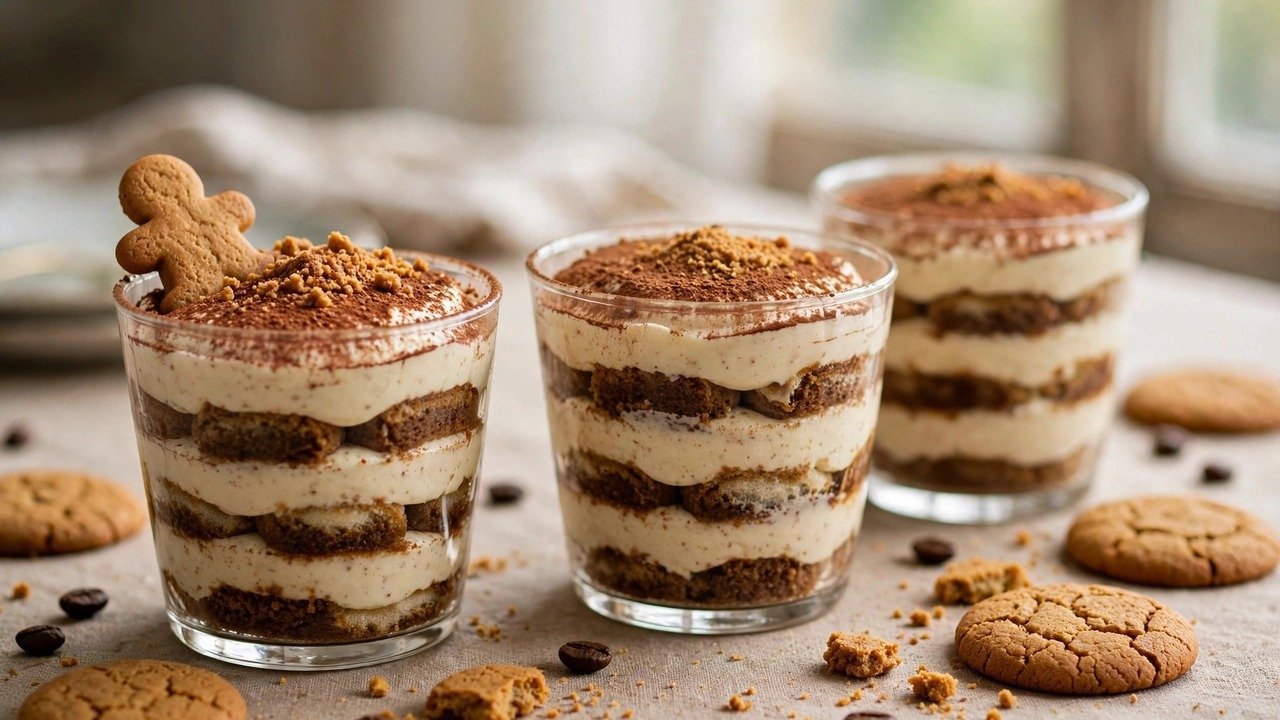
Tiramisu, but make it Christmas. Coffee-dipped gingersnaps stand in for ladyfingers, the mascarpone cream is spiced with ginger, cinnamon, nutmeg and cloves, and a spoonful of molasses runs through both the coffee and the cream, so every layer tastes like gingerbread. The cups are individual, so there is no slicing, no collapsing tower, and everyone gets the same neat layers.
There is no baking and no raw egg. The yolks are whisked with sugar over simmering water until they reach 160°F (71°C) — a sabayon — which makes the cream safe for everyone and gives it a silkier, more stable body than the raw-yolk version. The active work takes about 30 minutes; the fridge does the rest.
At a glance
- Makes: 8 cups (6 oz / 180 ml dessert cups)
- Time: 30 minutes active work, 6 hours minimum chilling (overnight is better), 6 hours 30 minutes total
- Course: Dessert — no-bake, make-ahead
- Cuisine: American, Italian-inspired
- Why this recipe: all the gingerbread flavour of the holidays in individual cups, with a cooked sabayon so there is no raw egg
- Storage: covered in the fridge for 3 to 4 days; they actually taste best on day two. Do not freeze.

Why you’ll love this recipe
- No raw egg, no compromise. The yolks are cooked to 160°F (71°C) in a sabayon, so the cream is safe for everyone, with a silkier, more stable body than the raw-yolk version.
- Real gingerbread flavour in every layer. Molasses and ginger in the coffee the cookies soak in, molasses and a full spice mix in the cream, and a cinnamon-dusted cocoa finish on top — the cookies are gingersnaps, not ladyfingers, so the flavour is in the structure, not just sprinkled on it.
- Made for the day before. The cups need at least 6 hours in the fridge anyway and taste best on day two.
- Individual cups, no slicing. Everyone gets the same neat layers, with no collapsing tower to worry about at the table.
Notes on ingredients
- Crisp gingersnaps — the backbone of the dessert — they need to be crisp, not soft or chewy. Crisp cookies hold up to dipping and soften into a cake-like layer in the fridge; soft ones fall apart in the coffee. Gluten-free gingersnaps work too, as long as they are crisp.
- Strong coffee or espresso — brewed strong, or double-strength (twice the usual grounds for the same water). Instant espresso powder dissolved in hot water works too. For children or anyone avoiding caffeine, use decaf — the flavour is barely different under all that spice.
- Unsulphured molasses — the deep, dark note that makes this taste like gingerbread rather than just spiced tiramisu, in both the coffee and the cream. No molasses? Use dark brown sugar instead — the flavour will be a little less deep, but the gingerbread character survives. A little brown sugar goes into the coffee too, to round out the molasses and the bitterness.
- Egg yolks — at room temperature, whisked with sugar over simmering water into a sabayon — that cooking step is the whole point: it makes the yolks safe to eat and gives the cream its body. For extra certainty, use pasteurized shell eggs or carton pasteurized yolks, or the egg-free variation below.
- Granulated sugar — whisked with the yolks for the sabayon; it sweetens the cream and helps the yolks cook smoothly without scrambling.
- Mascarpone — at room temperature for 30 minutes before you start, beaten for no more than about 30 seconds. Cold or over-beaten mascarpone turns grainy and can split. There is no good low-fat swap — light cream will not whip, and low-fat spreads are too soft to hold the layers.
- Heavy cream — cold, so it whips, to medium-stiff peaks — it should hold its shape when you lift the beaters but still look glossy, not dry. Over-whipped cream turns grainy and will not fold smoothly.
- Ground ginger, cinnamon, nutmeg and cloves — the spice mix that makes the cream taste like gingerbread, with vanilla to round it out. Freshly grated nutmeg is best if you have it, but ground works fine.
- Dutch-process cocoa powder — for dusting the tops just before serving, mixed with a little cinnamon — not before chilling, or it goes soft and patchy.
- Mini gingerbread cookies — optional, for standing in each cup at serving — check the label, as they sometimes contain nuts.
Find the complete recipe with measurements below, in the recipe card.
How to make gingerbread tiramisu cups
Stage one: Make the gingerbread coffee
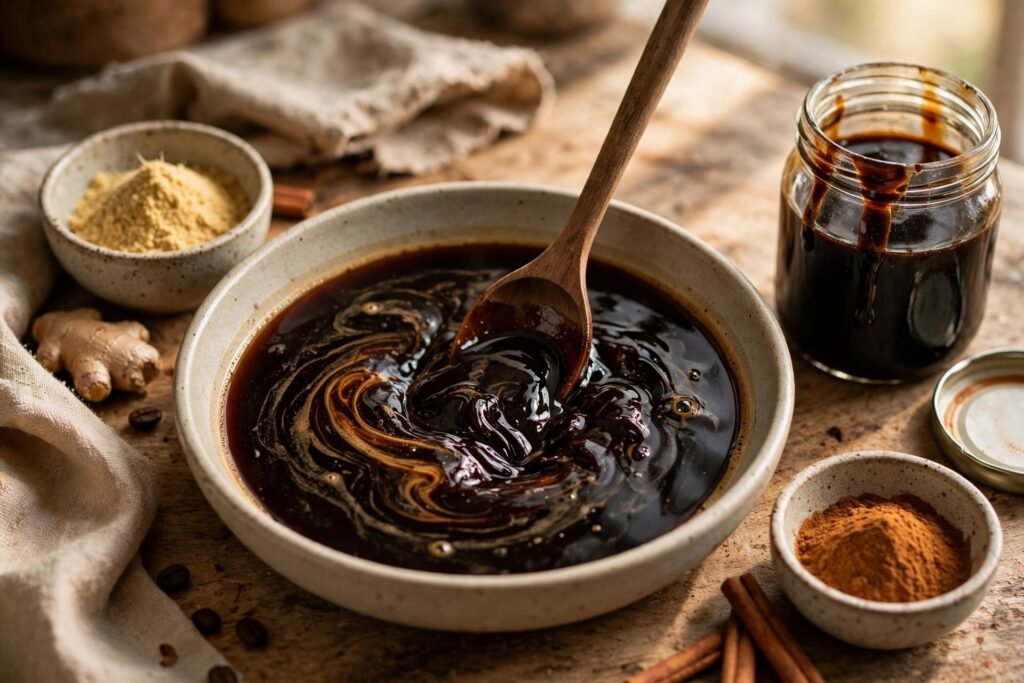
Brew the coffee strong — espresso, or double-strength brewed coffee. While it is still hot, stir in the molasses, brown sugar, ginger and cinnamon until dissolved, then pour it into a shallow dish and cool completely, about 20 minutes. Warm coffee melts the cookies on contact and makes the layers soggy, so do not rush this.
Stage two: Cook the sabayon and build the cream
Set a heatproof bowl over a saucepan of simmering water — the bowl must not touch the water. Add the egg yolks and granulated sugar and whisk constantly, scraping the sides, for 6 to 8 minutes, until pale, thick and ribbony and a thermometer in the centre reads 160°F (71°C). That temperature is the whole point: it is the point at which the yolks are safe to eat, and it is what gives the cream its body. This cooked-sabayon method is the standard way to make tiramisu without raw eggs — Rustic Cucina explains it step by step. Take the bowl off the heat, whisk 1 minute more, then cool about 10 minutes, until just warm to the touch — if it cools completely it stiffens; if it is still hot it melts the mascarpone.
While the sabayon cools, whip the cold heavy cream on medium-high until medium-stiff peaks form, 2 to 3 minutes. In a separate bowl, beat the room-temperature mascarpone with the molasses, vanilla, spices and salt on low speed for about 30 seconds, just until smooth. Pour the cooled sabayon into the mascarpone and fold until no streaks remain, then add the whipped cream in two additions, folding with large, gentle strokes and turning the bowl as you go. Stop as soon as the mixture is uniform and thick enough to hold a soft peak.


Stage three: Dip and layer
Dip each gingersnap in the cooled coffee for 1 to 2 seconds per side — a quick in-and-out, not a soak, since the cookies keep absorbing coffee after you lift them. Break each dipped cookie into 2 or 3 pieces and divide them among the 8 cups, about 1½ cookies per cup for the first layer. Spoon a generous layer of mascarpone cream over the cookies and spread it gently to the edges. Repeat with another layer of dipped cookies, then the rest of the cream, divided evenly, and smooth the tops with the back of a spoon. Use clear cups if you can — half the appeal is seeing the layers.

Stage four: Chill and finish
Cover the cups and refrigerate for at least 6 hours. Overnight is noticeably better: the cookies soften into a cake-like layer and the flavour deepens. Four hours is the minimum — any less and the layers slide when you spoon into them. Just before serving, mix the cocoa powder with the cinnamon and dust it over the tops through a fine sieve, scatter the crushed gingersnap crumbs over the cocoa and, if you like, stand a mini gingerbread cookie in each cup. Serve cold, straight from the fridge, with small spoons.

Tips that make the difference
- Cold cream, room-temperature mascarpone. Cream whips only when cold; mascarpone blends only at room temperature. Get both right and the folding takes two minutes.
- Dip, do not soak. One to two seconds per side is enough — gingersnaps keep drinking coffee after they leave the dish, and a five-second dip gives you mush by the time the cups chill.
Storage and reheating
Cover the cups and keep them in the fridge. They keep for 3 to 4 days and taste best on day two, once the layers have settled. Add the cocoa dusting and crumbs only when you serve them.
There is no reheating: it is a chilled dessert, served cold from the fridge. Do not leave the cups at room temperature for more than 2 hours; the mascarpone cream is a dairy product and spoils quickly once warm. Do not freeze them — the mascarpone turns grainy after thawing and the cookies lose their layered texture.
Variations
- Boozy version: Stir 2 tablespoons of dark rum, coffee liqueur, or Irish cream into the cooled coffee. The alcohol is uncooked, so this version is for adults only.
- Chocolate gingerbread: Add 2 tablespoons of Dutch-process cocoa powder to the mascarpone cream with the spices. The cream turns a light mocha colour and the dessert leans more chocolate than spice.
- Biscoff version: Use speculoos (Biscoff) cookies instead of gingersnaps and skip the molasses in the coffee — the flavour is caramel-spiced rather than gingerbread, and the cookies hold up just as well.
- Egg-free: Skip the yolks and sugar; beat the mascarpone with the molasses, vanilla, spices and a little extra powdered sugar, then fold in the whipped cream. The filling will be lighter and a touch less rich, and it still sets.
- Ladyfingers instead of gingersnaps: Use crisp ladyfingers (savoiardi), broken in half, and dip each piece for only 1 second per side — they absorb liquid far faster than gingersnaps and turn to mush if they soak. The gingerbread flavour will be milder, since the cookies themselves are plain.
- Mini cups for a crowd: Halve the layers into small cups — one cookie layer and one cream layer each, topped the same way. Chill time drops to about 4 hours.
- Dairy-free: The closest swap is a dairy-free mascarpone-style spread plus coconut cream whipped from a chilled can of full-fat coconut milk — expect a faint coconut note and a softer set, and chill the cups overnight.
Allergens and dietary information
- Milk / dairy: Mascarpone and heavy cream are the backbone of the filling, with no good low-fat swap — light cream will not whip, and low-fat spreads are too soft to hold the layers.
- Egg: The yolks are cooked to 160°F (71°C) in the sabayon, so the dessert is safe for most people, including pregnant people and young children. For extra certainty, use pasteurized shell eggs or carton pasteurized yolks.
- Wheat / gluten: Gingersnaps contain wheat — use certified gluten-free gingersnaps for a gluten-free version, and check that your cocoa powder is labelled gluten-free.
- Caffeine: Each cup holds roughly the caffeine of half a shot of espresso. For children or anyone avoiding caffeine, brew the coffee with decaf.
- Nuts: Nut-free as written. The optional mini gingerbread cookies sometimes contain nuts, so check the label if it matters.
You may also like
- Pumpkin Cream Cheese Muffins — another make-ahead sweet bake for a holiday table, with the same cream-cheese richness.


Gingerbread Tiramisu Cups
Ingredients
Equipment
Method
- Brew the coffee strong — espresso, or double-strength brewed coffee. While it is still hot, stir in the molasses, brown sugar, ground ginger and cinnamon until dissolved. Pour it into a shallow dish and leave it to cool completely, about 20 minutes.
- Set a heatproof bowl over a saucepan of simmering water — the bowl must not touch the water. Add the egg yolks and granulated sugar and whisk constantly, scraping the sides, for 6 to 8 minutes, until pale, thick and ribbony and a thermometer in the centre reads 160°F (71°C). Take the bowl off the heat, whisk 1 minute more, then cool about 10 minutes, until just warm to the touch.
- While the sabayon cools, whip the cold heavy cream in a large bowl on medium-high until medium-stiff peaks form, 2 to 3 minutes. The cream should hold its shape when you lift the beaters but still look glossy, not dry.
- In a separate medium bowl, beat the room-temperature mascarpone with the molasses, vanilla, ground ginger, cinnamon, nutmeg, cloves and salt on low speed for about 30 seconds, just until smooth. Do not beat it longer: mascarpone turns grainy and can split if overworked.
- Pour the cooled sabayon into the mascarpone and fold with a rubber spatula until no streaks remain. Add the whipped cream in two additions, folding with large, gentle strokes and turning the bowl as you go. Stop as soon as the mixture is uniform and thick enough to hold a soft peak.
- Dip each gingersnap in the cooled coffee for 1 to 2 seconds per side — a quick in-and-out, not a soak. Break each dipped cookie into 2 or 3 pieces and divide them among the 8 cups, about 1 1/2 cookies per cup for the first layer. Spoon about 3 tablespoons of mascarpone cream over the cookies in each cup and spread gently to the edges. Repeat with another layer of dipped cookies and the rest of the cream. Smooth the tops with the back of a spoon.
- Cover the cups with plastic wrap or lids and refrigerate for at least 6 hours. Overnight is noticeably better: the cookies soften into a cake-like layer and the flavour deepens. Four hours is the minimum — any less and the layers slide when you spoon into them.
- Just before serving, mix the cocoa powder with the 1/2 teaspoon of cinnamon and dust it over the tops through a fine sieve. Scatter the crushed gingersnap crumbs over the cocoa and, if you like, stand a mini gingerbread cookie in each cup. Serve cold, straight from the fridge.
Notes
Frequently asked questions
Do gingerbread tiramisu cups contain raw eggs?
No. The egg yolks are whisked with sugar over simmering water until they reach 160°F (71°C), which cooks them while keeping the cream light. For extra certainty, use pasteurized shell eggs or carton pasteurized yolks, or make the egg-free version in the variations section.
Can I make gingerbread tiramisu cups without eggs?
Yes. Skip the yolks and sugar entirely. Beat the mascarpone with the molasses, vanilla, spices and 2 extra tablespoons of powdered sugar, then fold in the whipped cream. The filling is lighter and a little less rich, but it still sets and tastes like gingerbread.
How long do gingerbread tiramisu cups need to chill?
At least 4 hours for the layers to set, 6 hours for a properly firm spoonful, and overnight for the best flavour. Do not serve them after only an hour — the layers will slide apart.
Can I use ladyfingers instead of gingersnaps?
Yes, use 16 crisp ladyfingers (savoiardi), broken in half. Dip each piece for only 1 second per side — ladyfingers absorb liquid much faster than gingersnaps and turn to mush if they soak. The gingerbread flavour will be milder, since the cookies themselves are plain.
Why is my mascarpone cream grainy or lumpy?
Almost always one of two things: the mascarpone was still cold from the fridge, or it was beaten too long. Mascarpone needs 30 minutes at room temperature before you start, and no more than 30 seconds of beating. Once it turns grainy, it cannot be smoothed out again.
Can I make gingerbread tiramisu cups ahead of time?
Yes, they are built for it. Assemble the cups up to 2 days ahead and keep them covered in the fridge. Add the cocoa dusting, crumbs and mini cookies just before serving so they stay crisp and bright.
How long do gingerbread tiramisu cups keep?
Covered in the fridge, 3 to 4 days. After that the cookies get too soft and the cream can start to separate. Do not freeze them — the mascarpone turns grainy after thawing.
Are gingerbread tiramisu cups alcohol-free?
Yes, as written. The optional variation adds 2 tablespoons of dark rum or coffee liqueur to the coffee, and that version is for adults only. The cups do contain caffeine from the coffee, so use decaf if you are serving children.
